


Marching to The Internationale, workers’ unions and other groups took to the streets of Taipei yesterday for the “Labor Day Anti--Poverty Parade” and used the occasion to convey their dissatisfaction with working conditions to the administration of President Ma Ying-jeou (馬英九).
Labor activists said a number of factors, including deteriorating work environments in a wide range of industries and an inadequate social security system, had contributed to increased worker exploitation and unfair treatment by employers.
The parade, which drew an estimated 3,000 protesters, started at the old Songshan Tobacco Plant, stopped to regroup and demonstrate in front of The Palace (帝寶), then proceeded onto Ketagalan Boulevard, where the marchers reiterated their four main slogans — anti--poverty, anti-overwork, equality and tax reform.
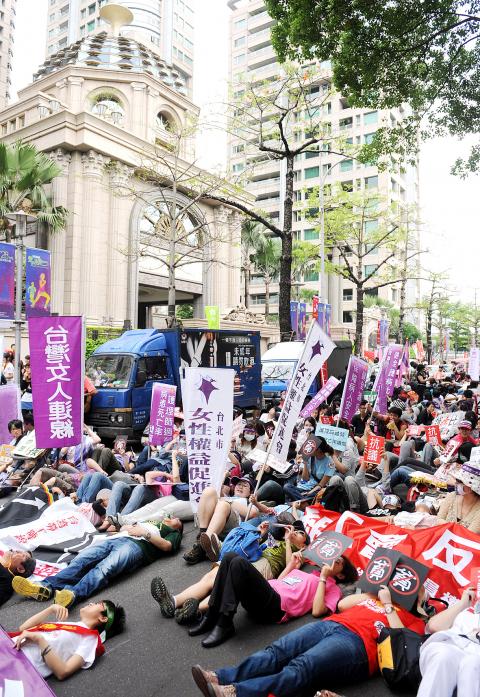
Photo: Chang Chia-ming, Taipei Times
Workers’ unions also lamented the fact that the minimum wage has been raised once since 2007, adding that they would not accept anything less than NT$22,115 a month. The minimum wage was raised by NT$600 last year, bringing it to NT$17,880 a month.
In light of the 3 percent raise for civil servants, military personnel and public school teachers that was announced last month, the trade unions and workers said they would ask for an increase to the minimum wage that was more than 3 percent.
Taiwan Labor Front secretary-general Son Yu-lian (孫友聯) said the rising cost of education often forced students from poor households to take out loans just to complete their degrees, which meant they were indebted even before they entered the job market.
With more young people in debt, these people might be poor all their lives, Son said, adding that the government, no matter which political party won the presidential election next year, cannot avoid addressing this problem.
Son also called on participants at the parade to “punish” the Ma administration with their vote next year should his government fail to provide a satisfactory response to their demands.
While passing in front of The Palace — one of the most expensive residential complexes in the city — participants in the parade all laid down on the ground and pointed their signs with the slogan “anti-poverty” skywards — a move aimed at highlighting the growing wealth gap in Taiwan.
Pointing at The Palace, a spokesperson said they were not protesting against the wealthy, but rather the government, because it was government policies that have allowed some people to live in expensive penthouses, while others cannot even afford a simple house.
Participants called on the government to consider reforming the tax system so that it would be less unfair to ordinary people.
Labor activists said regulations had loopholes that allowed large corporations and wealthy people — especially investors in the stock and real-estate markets — to evade taxes, while ordinary people were left to pay every last penny in taxes.
Son said the Ma administration’s Selective Goods and Services Sales Tax Act (特種貨物及勞務稅條例) would not result in higher wages for ordinary people and would fail to make the wealthy pay more taxes.
Regarding demands by workers’ and trade unions to reign in the problem of excessive work hours, the Council of Labor Affairs said it would cut the number of work hours to 80 a week as per the Labor Standards Act (勞動基準法).
Several labor, migrant worker and Aboriginal groups also staged a demonstration outside the Executive Yuan yesterday morning, protesting the government’s role in the repression of labor, and called on the public to boycott the nation’s major political parties in the next legislative election.
The organizers said the government — whether Chinese Nationalist Party (KMT) or Democratic Progressive Party (DPP) — was unfriendly to workers and was an accomplice in the repression of workers.
“The capitalists repress the workers and the government stands with them. The government helps the capitalists to repress workers. They are all the same,” Ho Kuang-wan (賀光卍), who represents the Taiwan Association for Victims of Occupational Injuries, told the crowd.
“A lot of people are working such long hours everyday that their health is threatened,” Ho said. “Instead of helping workers out, the government adjusted regulations in favor of employers and encouraged workers to exercise more.”
Ko Yi-min (柯逸民), convener of Raged Citizens Act Now, said Workers’ Day should not become a day for the government to honor “model workers,” because “it’s a day to commemorate workers’ struggles for their social, economic and political rights.”
The demonstrators also performed a short skit in which two actors representing the KMT and the DPP fight with each other on stage, before interacting in a friendly manner once off the stage, all the while ignoring the workers and Aborigines who were voicing their grievances.
An actor and an actress playing ordinary workers said that they endured long working hours, low wages and unstable employment.
An Amis activist said that Aborigines suffer from long-term unemployment, but when they want to return to their home villages, they frequently find the government has designated their traditional lands as natural reserves, for official use or as construction sites for resorts.
“We, the people, want to be the real masters of this country — all the time as it should be, not just on election days,” said Chou Chia-chun (周佳君), a representative of the Urban Workers’ Alliance for Political Participation, adding that labor groups are considering endorsing their own members to run in January’s legislative election.
Reacting to yesterday’s protests, Ma did not offer any concrete promises, but said his administration would listen to the protesters’ demands and make improvements.
He said that three revised labor laws implemented yesterday were of “epoch-making” significance and an “historic miracle.”
Ma was referring to the Labor Union Act (工會法), the Collective Bargaining Agreement Act (團體協約法) and the Settlement of Labor Disputes Act (勞資爭議處理法).
Only one item was amended during his presidency.
The Labor Union Act was last revised in June last year, but the Executive Yuan did not decide when to implement the revisions until four months later. Nevertheless, only one article of the amended law came into force — in December last year.
Both the Collective Bargaining Agreement Act and Settlement of Labor Disputes Act were last amended under the former DPP administration, which was in office from 2000 until 2008.
Ma said Taiwan had seen impressive economic growth in the past two years. Unemployment has continued to drop for 19 consecutive months and was down to 4.48 percent in March, he said. Every job seeker has an average of 1.73 job opportunities and businesses have complained that they have a shortage of workers, he said, adding that 250,000 more people found jobs in March compared with the same period last year.
Despite the impressive economic figures, Ma said he realized the allocation of income should be more fair. Ma said social welfare programs were the best way to close the widening gap between rich and poor.

The National Chungshan Institute of Science and Technology yesterday showcased its locally developed variants of the Vision 60 robotic patrol dog, which it plans to deploy on the nation’s outlying territories in the South China Sea. The variants were produced under the Joint Lab project — created by the institute and domestic companies — and assembled with domestically produced motors, lenses and artificial intelligence (AI) systems alongside licensed tech from the US, Missile and Rocket Systems Research Division deputy director Jen Kuo-kang (任國光) told the media event at a military base in Taipei’s Dazhi (大直) area. Taiwan has built up its strengths

RIGHT DIRECTION: Taiwan’s efforts to prevent forced labor include a proposal to ‘fully prohibit’ employers from withholding workers’ documents, an official said Taiwan is to establish a mechanism to restrict imports of goods linked to forced labor, the Executive Yuan said yesterday, after the US proposed imposing additional tariffs on Taiwanese goods over labor concerns. “The Ministry of Labor and the Ministry of Economic Affairs are to establish an interministerial review procedure,” Executive Yuan spokesperson Michelle Lee (李慧芝) said at a news briefing in Taipei. “The government is to use the Foreign Trade Act [貿易法] as the legal basis to restrict imports of goods produced with forced labor” and bring its supply chain governance more in line with international standards on human rights, resilience

NOT IMMEDIATE: Taiwan has a chance to appeal the proposed 10 percent tariff before it starts, while other countries face a 12.5 percent tariff from the trade office Taiwan is among 60 economies determined by the US to have failed to impose or enforce a ban on the importation of goods produced with forced labor, according to a notice released on Tuesday by the Office of the US Trade Representative (USTR), which proposed imposing an additional 10 percent or more tariff on them. The USTR in a statement said that following an investigation, it had determined under Section 301 of the Trade Act of 1974 that the failure of the 60 economies to impose and effectively enforce a prohibition on the importation of goods produced with forced labor is

TIT-FOR-TAT: The US allegedly revoked the visa of a Chinese national working at Xinhua News Agency in the US in response to Beijing’s expulsion of Vivian Wang The Presidential Office yesterday condemned China for expelling a New York Times correspondent from Beijing following the newspaper’s interview with President William Lai (賴清德), saying the move highlighted Beijing’s suppression of press freedom and its threat to international news media. Taiwan has noted a series of recent incidents in which Beijing used similar tactics to “threaten and pressure international media outlets and journalists,” Presidential Office spokeswoman Karen Kuo (郭雅慧) said in a statement. “This concerns not only press freedom and freedom of expression, but also the safety of journalists, and Taiwan and relevant partners are paying close attention to the situation,” she


 RSS
RSS